
INTRODUCTION
Every plant manager knows the line items on an electricity bill: units consumed, maximum demand, fuel surcharge, fixed charges, taxes. Most know approximately what each one should be and notice when it moves in the wrong direction. But there is one factor that could be the reason behind almost every inflated electricity bill in India’s industrial sector, and most plant teams either do not see it or do not fully understand it.
That is power factor.
Power factor improvement is not a new concept. Electrical engineers have been talking about it for decades. Yet, across industries like steel plants, cement factories, pharmaceutical units, commercial buildings, and water utilities, poor power factor continues to cost businesses money every single month; not because the solution is complicated, but because the problem is invisible.
This article explains what power factor is, why a poor power factor costs you money, and what power factor improvement looks like in practice — in plain language, without the electrical engineering degree.
Power factor is simply the ratio of active power to apparent power. Simply put, how much of the electricity being delivered to your plant is doing useful work versus how much is just generating reactive current that bounces back and forth in your cables and transformers.
A power factor of 1.0 (or unity) means 100% of the power delivered is doing useful work.
A power factor of 0.7 means that for every 100 units of apparent power your utility has to supply, only 70 units are doing anything productive. The other 30 units are reactive and your utility infrastructure has to carry all 100.
In India, most state electricity boards and distribution companies impose a power factor clause in their tariff structures. If your average power factor falls below a defined threshold (typically 0.90 or 0.95 depending on your state and tariff category), you are charged a penalty in the form of a surcharge applied to your total electricity bill for that month.
In Maharashtra, for instance, the MSEDCL tariff structure imposes surcharges for power factor below 0.90 and offers incentives for maintaining power factor above 0.95. The difference between a facility running at 0.80 and one running at 0.95 can amount to lakhs of rupees per year in avoided penalties alone.
Many industrial tariff categories in India bill on the basis of kVAh (kilovolt-ampere hours) rather than kWh (kilowatt hours). kVAh is apparent energy, which means it includes both the useful active component and the wasteful reactive component. A low power factor directly increases your kVAh consumption even if your actual productive energy use (kWh) stays the same.
Power factor improvement reduces kVAh consumption by reducing the reactive component, meaning you pay for less energy even though your plant is doing exactly the same amount of productive work.
Poor power factor forces more current through your cables, transformers, and switchgear than the active load alone would require. This inflated current increases your recorded maximum demand (kVA), which is typically billed separately and carries its own tariff. Reducing reactive current through power factor improvement directly reduces your maximum demand reading and its associated cost.
The excess reactive current flowing through your electrical network generates heat — heat in cables, transformer windings, busbars, and switchgear. This wasted energy shows up as higher electricity consumption. It also accelerates wear on insulation and shortens the life of electrical assets. Power factor improvement reduces this current, cutting losses and extending equipment life simultaneously.
A facility running at a power factor of 0.75 is carrying roughly 33% more current through its cables and transformers than it needs to. That excess current costs money in losses, in penalties, and in premature equipment wear and tear.
Power factor improvement is achieved by adding reactive power locally. By supplying the reactive (capacitive) current from capacitor banks installed within the plant, power does not have to be drawn from the grid. The result is a cleaner, more efficient electrical system that draws less apparent current for the same active load.
The solution can be fixed or automatic depending on the load profile:
• Fixed capacitor banks: Suitable for stable, consistent loads where the reactive demand does not change significantly.
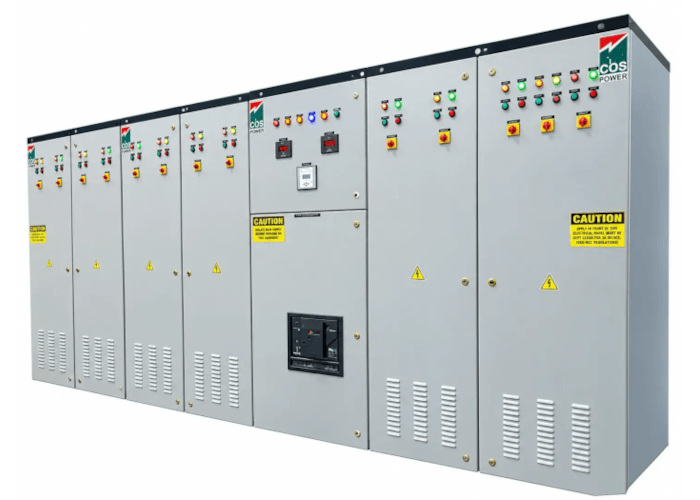
• Automatic Power Factor Correction (APFC) panels: Use a microcontroller-based relay to switch capacitor banks in and out automatically as load varies, maintaining target power factor in real time.
• Real-Time Power Factor Correction (RTPFC) panels: Thyristor-switched for ultra-fast response, ideal for rapidly fluctuating loads such as arc furnaces, rolling mills, and frequent motor starts.
This is usually the first question a plant manager or finance head asks and the answer is often surprising. For most industrial facilities with a poor power factor, the combined savings from avoided penalties, reduced kVAh billing, and lower maximum demand charges mean that a properly specified power factor correction system pays for itself in under 12 months. In many cases, payback is achieved in 6–9 months.
The calculation is straightforward: take your current monthly electricity bill, identify the power factor penalty and kVAh excess, model the reduction after correction, and divide the system cost by the monthly saving. The numbers rarely disappoint.
Power factor is not a technical abstraction, rather it is a direct financial cost that most industrial plants are paying without fully realising it. The solution is well-established, the equipment is reliable, and the payback is fast. The only thing standing between most facilities and meaningful savings is awareness and a properly specified system.
If you have not reviewed your plant’s power factor recently, your next electricity bill is a good place to start. Look for the power factor reading, the kVAh consumed, and any power factor penalty line. The numbers will tell you whether it is time to act.
CTA
Want to know how much your facility could save with power factor improvement? Talk to Cospower’s engineers for a free assessment.