
In industrial plants, substations, steel mills, cement factories, and fertiliser units across India and beyond, there is a power quality problem that builds up slowly as the motor windings heat up or the capacitor ages. It is seen through a gradual increase in electricity bills and sometimes a trip of a relay.
The solution to this is proven and well-established: the need for a harmonic filter.
This article explains what harmonic distortion is, why it is so damaging in non-renewable industrial environments, how a harmonic filter works, and what to look for when specifying one for your plant.
To understand what a harmonic filter is and how it works, let’s first understand what iHarmonic Distortion?
Electrical power systems are designed to operate on a clean sinusoidal waveform (in India, at 50 Hz). But modern industrial plants are full of equipment that does not draw current in that clean sinusoidal pattern. Variable frequency drives (VFDs), rectifiers, arc furnaces, welding machines, UPS systems, and switch-mode power supplies all draw current in pulses rather than smooth waves. These pulses inject currents at frequencies that are integer multiples of the fundamental:150 Hz (3rd harmonic), 250 Hz (5th harmonic), 350 Hz (7th harmonic), and so on.
The result is a distorted current and voltage waveform.
The degree of distortion is measured as Total Harmonic Distortion, or THD. And while a small amount of THD is tolerable, levels above the limits set by IEEE 519-2024 begin to cause real, measurable damage.
Common sources of harmonic distortion in non-renewable plants
The Real Cost of Unfiltered Harmonics in Industrial Plants
The consequences of unchecked harmonic distortion in a non-renewable industrial environment are not theoretical. They gradually make their way in through maintenance records, electricity bills, and finally in equipment failures and noticeable downtimes.
Capacitor banks installed for power factor correction are among the first casualties of harmonic distortion. Capacitors present low impedance to high-frequency harmonic currents and unstable currents may cause overheating, dielectric breakdown, and premature failure.
Plants that experience frequent, unexplained capacitor failures almost always have a significant harmonic distortion problem that has not been addressed.
A well designed harmonic filter, particularly one with a series reactor, detunes the capacitor bank from resonant frequencies and protects it from this overcurrent damage.
Harmonic currents flowing through motors and cables increase the RMS current beyond what the fundamental load alone would produce. This causes additional heating in windings and conductors. Over time, this can accelerate the insulation, causing wear and tear in the motors and cables, and thereby leading to failures and unplanned downtime.
Installing a harmonic filter reduces the harmonic content of the current and brings RMS values back toward design levels, positively impacting the operational life of motors and cables.
Protection relays, especially those found in older electromechanical types are prone to malfunction when exposed to distorted waveforms. Harmonic currents can cause incorrect operation of relays and may lead to tripping circuits that should remain in service or, sometimes may even fail to trip circuits that should be isolated. This compromises plant safety and availability simultaneously.
Harmonic filters are known to reduce the chances of maloperation and tripping, leading to lower downtimes and increased outputs.
Harmonic currents increase eddy current and hysteresis losses in transformer cores, raising operating temperatures beyond design limits. A transformer that runs consistently hot has a shorter lifespan.
K-factor rated transformers mitigate this to a degree, but the better long-term solution is to reduce harmonic content at the source using a properly specified harmonic filter.
How a Harmonic Filter Works
A harmonic filter is a passive or active circuit element connected to the power system and is designed to reduce harmonic voltages and currents to acceptable levels.
Passive harmonic filters are the most widely used type in non-renewable industrial applications and consist of capacitors and reactors that are tuned to present low impedance at specific harmonic frequencies. Harmonic currents at those frequencies are diverted into the filter circuit rather than flowing into the supply network.
A well-designed passive filter simultaneously provides reactive power compensation, improving power factor, and suppresses harmonics.
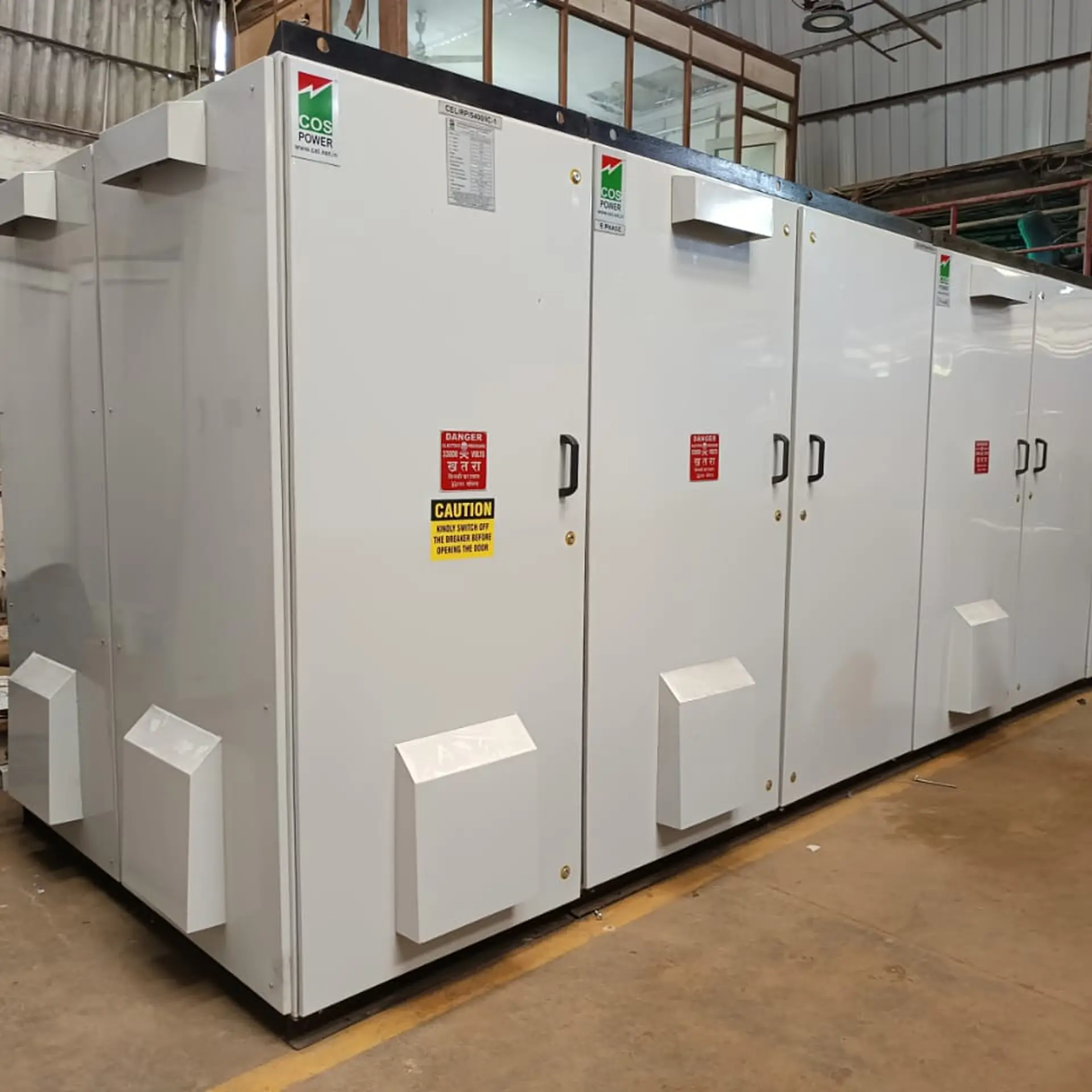
Cospower designs and supplies several types of passive harmonic filters depending on the harmonic spectrum and network characteristics of the site including:
Harmonic distortion is not just a plant reliability issue, it is also a regulatory one. IEEE 519-2024 defines limits for both current harmonic distortion (THD-I) and voltage harmonic distortion (THD-V) at the point of common coupling between an industrial consumer and the utility.
In India, the Central Electricity Authority (CEA) regulations and individual state utility supply codes impose harmonic limits on industrial consumers.
Exceeding these limits exposes a plant to financial penalties, demands for corrective action, and in serious cases, disconnection from the grid.
Remember, a properly designed harmonic filter brings distortion levels within the mandated limits and provides documented evidence of compliance, protecting the plant from regulatory risk.
How to choose the right harmonic filter for your plant?
Not every harmonic filter is appropriate for every application. Specifying the correct solution requires a site-specific harmonic survey, measurement of actual THD levels, identifying the dominant harmonic orders, understanding the network impedance, and assessing the interaction between any existing capacitor banks and the supply system.
At Cospower, every harmonic filter solution begins with this assessment. Our engineers use eTAP power system simulation software to model the plant network, predict filter performance, and verify compliance before a single component is procured. This simulation-driven approach eliminates the guesswork and ensures the delivered solution performs exactly as specified on day one.
Harmonic distortion is not a niche technical problem reserved for the most complex industrial environments. It is a present reality in virtually every industrial plant. The consequences are well documented: premature capacitor failures, motor and cable overheating, transformer losses, frequent tripping, and the slow, steady accumulation of energy waste and regulatory risk. None of these is inevitable; they are the predictable outcome of operating a modern industrial power system without adequate harmonic mitigation.
A tailor-made harmonic filter, therefore, is not an optional upgrade or a compliance box to be ticked before an audit. It is a fundamental component of a well-engineered power system and is essential to the long-term health of your electrical infrastructure. The economics are straightforward: the cost of a correctly specified harmonic filter is almost always a fraction of the cumulative cost of the equipment failures, energy losses, and penalties it prevents.
The technology is mature, the standards are clear, and the case for action is compelling. The only question worth asking is not whether your plant needs a harmonic filter, but whether you have the right one in place.
SYNOPSIS : Harmonic distortion is silently degrading equipment, shortening asset life, and costing industrial plants money every single day. Here’s what a harmonic filter does and why waiting to install one is a risk you cannot afford.